401 Richmond Illustration Studio
OCAD University’s RBC Centre for Emerging Artists & Designers is excited to announce the return of the 401 Richmond Illustration Studio for graduating Illustration students.
April 27, 2026

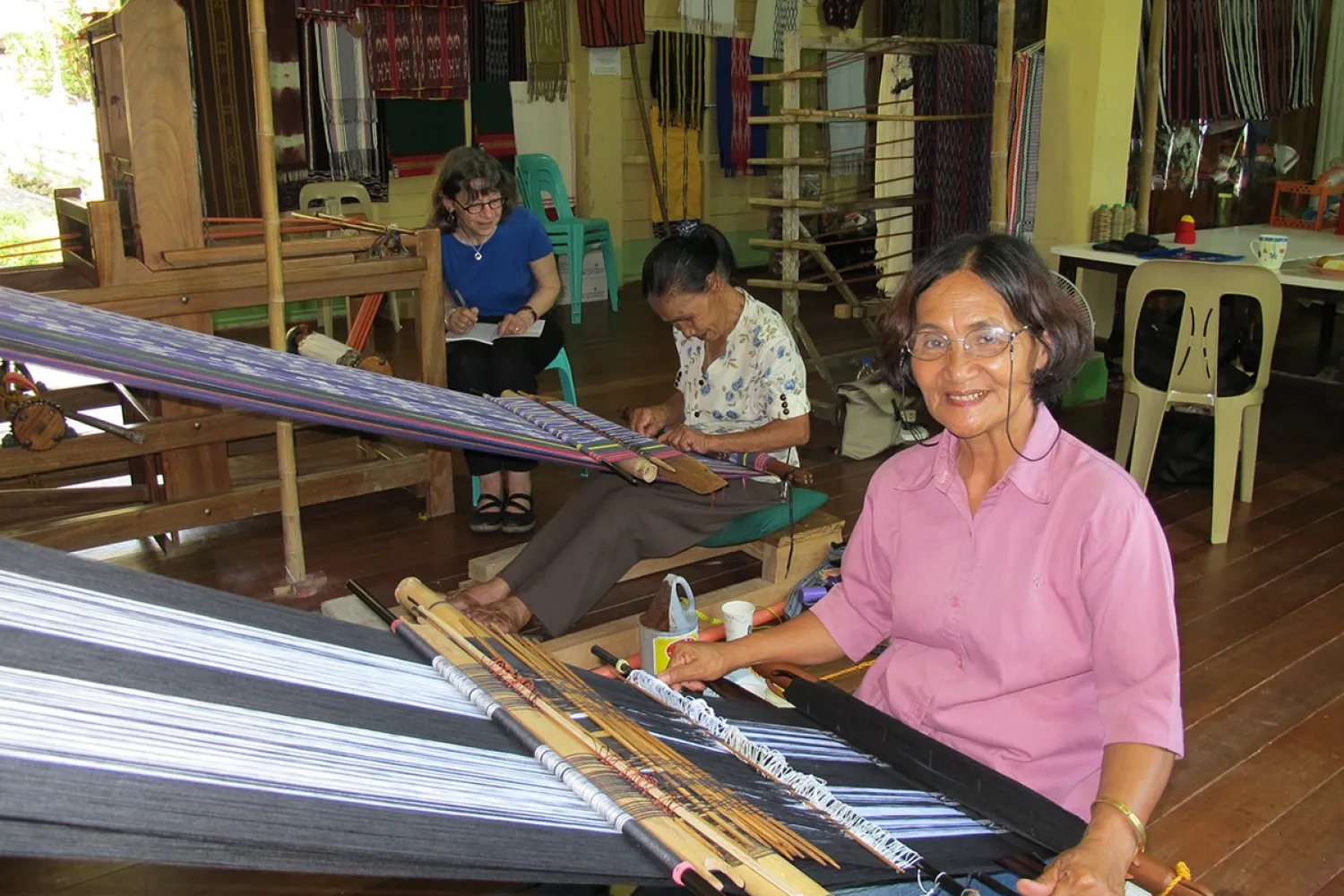
OCAD University Professor Emerit and Adjunct Professor in the Faculty of Arts and Science Dr. Lynne Milgram is a cultural and social anthropologist who continues to be a research affiliate with the Cordillera Studies Center, University of the Philippines Baguio.
Dr. Milgram began her professional career as an artist working in textile media (primarily weaving) and following extensive travel in East and Southeast Asia studying regional textile practices, she shifted her research focus to explore the social, economic and political conditions of artisanal production in both rural and urban contexts.
As curator at The Textile Museum of Canada, from 1976 to 1992, Dr. Milgram was subsequently able to bring these research inquiries to fruition by drawing on the museum’s collection and on contemporary textile artists’ production to mount exhibitions and publish exhibition catalogues. From 2001 to 2021, as a professor of Anthropology at OCAD U, she incorporated her research findings into her teaching curriculum and continued to conduct further ethnographic research with a focus on the Philippines.
OCAD U caught up with Dr. Milgram to learn more about her research.
What has been the main focus of your research inquiries?
My ongoing research, funded by the Social Sciences and Humanities Research Council of Canada (SSHRC), focuses specifically on the northern and central Philippines, analyzing the cultural politics of social change regarding people’s self-employed work across a range of “alternative” economic sectors such as producing and marketing crafts, street vending, the Philippine-Hong Kong second-hand clothing industry, and public market trade.
These Philippine enterprises straddle formal/informal and legal/illegal practice and are growing arenas of work given increasing rural-to-urban migration amid a lack of consistent income-generating employment in “mainstream” economic sectors.
I explore the channels through which those working in such other-than-formal-sector jobs can meet their daily subsistence needs while simultaneously supporting community welfare.
Investigating the socioeconomic and political impacts of Philippine development projects mounted to facilitate residents’ livelihoods across “formal-informal” sectors, I further analyze the relationship between the institutional claim to empowerment and the capacity of development programs to generate real opportunities for everyday workers.
Tell us about some recent research projects and the specific problems or questions these studies address.
My most recent Philippine research continues to problematize the concepts of informality, extralegality, governmentality and social entrepreneurship regarding the northern Philippines’ emergent Arabica coffee industry and Philippine artisans’ and entrepreneurs’ use of the internet to gain broader access to global markets.
My recently completed research project, which is closer to home, explored the issue of food security by exploring the alternative marketing and community-building practices of Philippine-Toronto entrepreneurs operating neighbourhood grocery and bakery stores.
Regarding Philippine artisanal production in both crafts and Arabica coffee, I have found that artisans have self-organized into associations to gain the equipment, skills training and marketing assistance they need to enhance their livelihoods given little Philippine government support.
To this end, a group of Philippine social entrepreneurs, which includes producers, has emerged whose mandate champions business transparency, quality production, ongoing producer-buyer relationships and community welfare initiatives.
These Philippine social entrepreneurs, as pragmatic social activists, combine an eclectic mix of business, charity, private and social movement models to establish social welfare initiatives for communities while facilitating practitioners’ livelihood security.
In this research, I question the extent to which artisanal producers and the entrepreneurs with whom they work can realize the potential of such a social entrepreneurial approach given shifts in raw material availability, labour conditions, market demand and precarity, and the degree to which products are expected to represent markers of both modernity and local cultural identity.
I further ask, can these social enterprises scale up from their smaller-scale origins and still maintain their social welfare mandate and do social entrepreneurs’ efforts simply alleviate symptoms rather than address root causes of inequality?
My research suggests, moreover, that social entrepreneurs’ efforts to date have, in fact, led to positive industry outcomes in both these fields. This encourages us to tweak a social entrepreneurial approach by continuing to pursue cross-sector advocacy that can curtail political and socioeconomic challenges to the sustainability of such small-scale, independent enterprises.
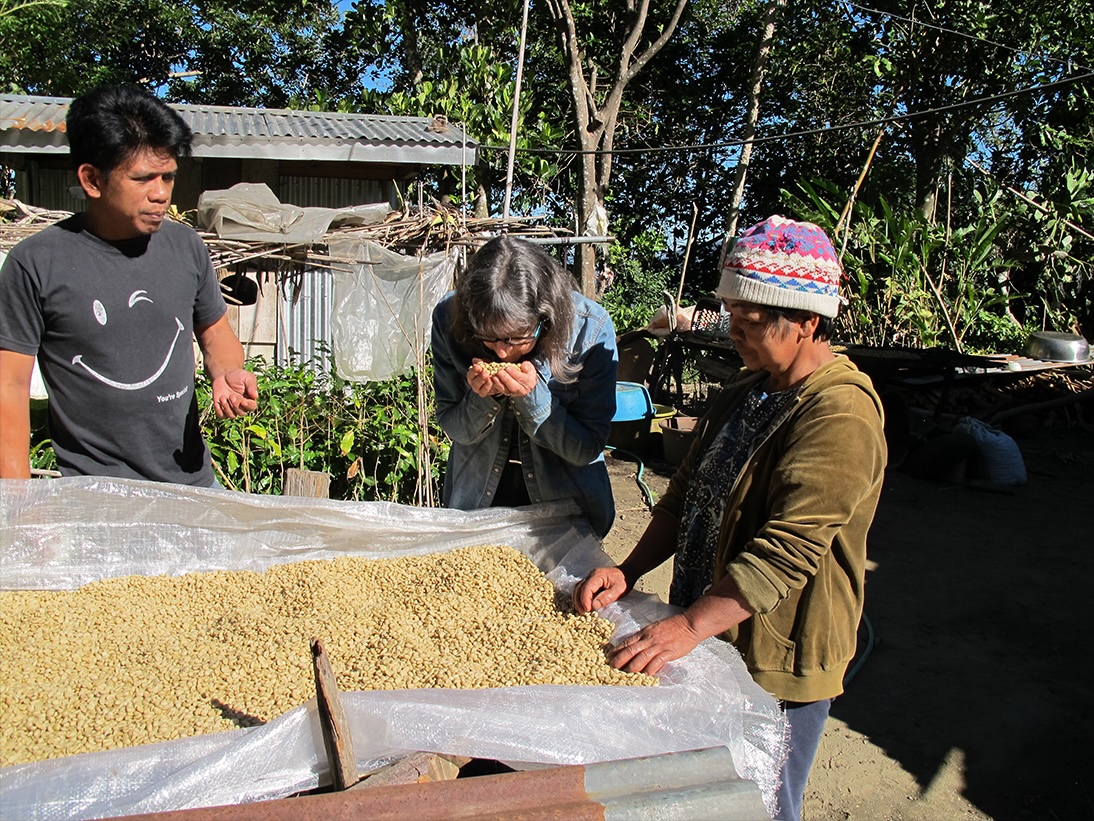
Pictured above: Dr. Lynne Milgram (centre) at an Arabica coffee social enterprise farm in Benguet province, Philippines. Photo credit: R. Busacay.
In what ways does your recently completed research with the Philippine-Toronto community facilitate understanding your earlier findings?
My most recent Philippine-Toronto research, Diasporic Entanglements: Philippine-Toronto Entrepreneurs Reinvent Food Provisioning, Business, and Belonging, has been part of broader collaborative SSHRC-funded projects with York University (Geography, 2015-19) and with the University of Toronto Scarborough (Culinaria Research Centre, 2021-24).
This Philippine-Toronto research analyzed small-scale Filipino prepared food businesses and neighbourhood convenience stores to demonstrate that many migrants who have generally been associated with displacement and deprofessoinalization can, in fact, operationalize both mainstream and alternative informal practices to establish viable yet quotient enterprises.
Offering Filipino prepared foods, imported groceries, and a range of transnational communication services, I demonstrated that these entrepreneurs activate socioeconomic connections locally and with businesses in the Philippines to connect society sectors not previously linked or connect them in different ways. They thus emerge as transnational migrant entrepreneurs who can create new interstitial socioeconomic spaces of work and community without physically having to leave their Toronto stores.
By adeptly navigating organizational skills and calculative risk taking while drawing on informal social relations, Philippine-Toronto migrant entrepreneurs’ practices materialize tiny cracks in neoliberal economies to demonstrate the potential of such emergent economic spaces and of community advocacy to realize socioeconomic change.
How do you see your research findings contributing to peoples’ everyday lives?
Throughout my research, I argue that producers and social entrepreneurs operationalize multiple work and social advocacy options to simultaneously negotiate their positions as sites of globally competitive economic activity and local struggles over state restructuring.
These research findings have been distributed across media such as peer-reviewed academic publications, which include open access sources, podcasts, videos, photo displays and public talks.
In addition, research findings have been shared with local government and non-government offices, and these are applicable for both policy formation and implementation by government and non-government organizations seeking to support livelihood opportunities and community welfare via a range of sustainable initiatives.
Selected publications re: the above projects.
2025 Diasporic Entanglements: Philippine-Toronto Migrant Entrepreneurs Craft
Alternative Transnational Food Enterprises. International Development Planning Review (IDPR).
2024 (Re)Crafting Digital Distribution Networks for Contemporary Philippine Textiles: Women’s Advocacy and Social Enterprise. In Gendered Threads of Globalization. Melia Belli Bose, ed., 180-206. Manchester, UK: University of Manchester Press.
2021 Social Entrepreneurship and Arabica Coffee Production in the Northern Philippines: Navigating Opportunities and Constraints. Human Organization 80(1): 72-82.