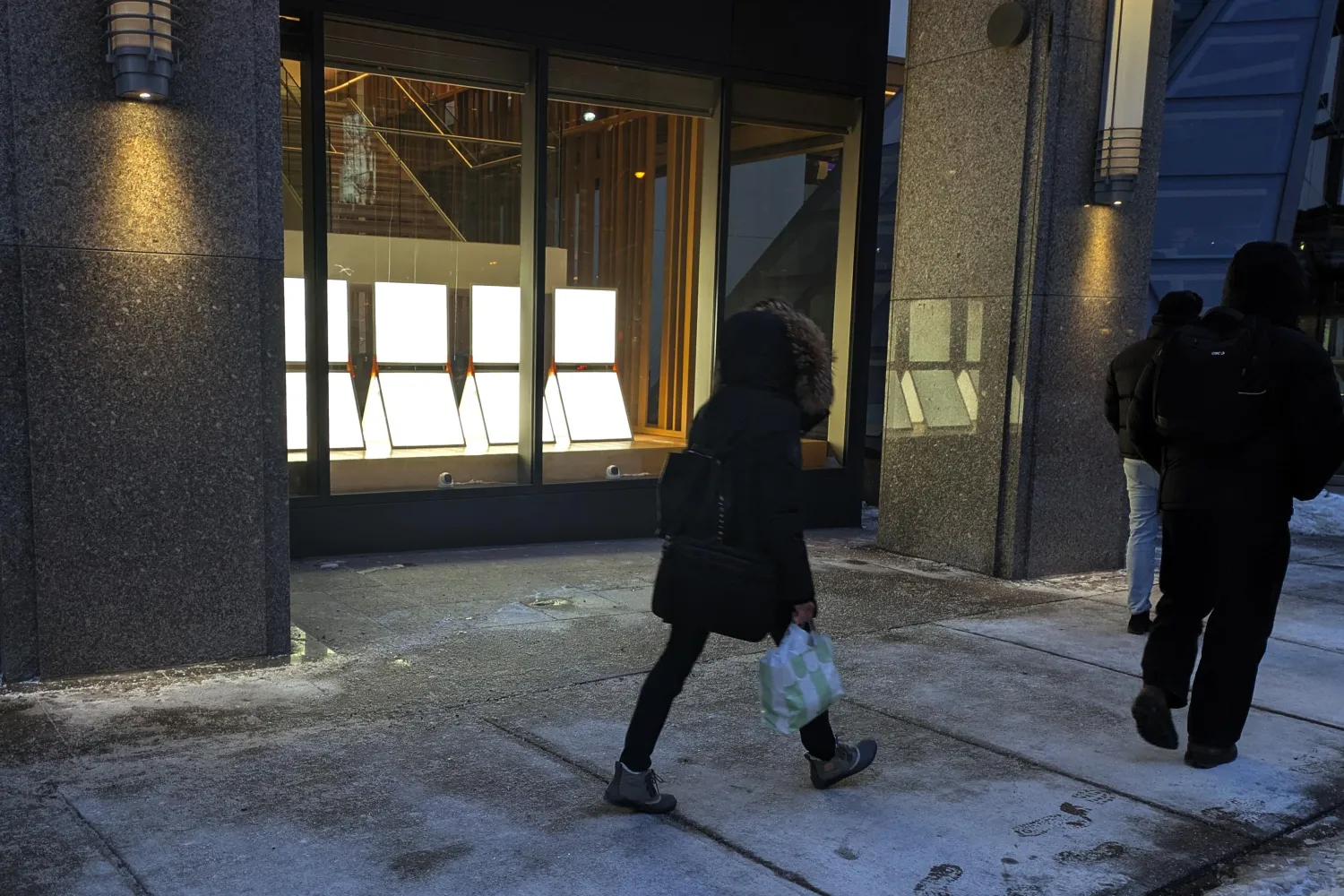
On a busy stretch of University Avenue, people hurry past glass towers, coffee in hand, eyes forward — not expecting the building to notice them.
But inside the window of the Haworth Canada showroom at 55 University Ave., a row of soft square light panels does.
The piece, Drop Ceiling v1, created by OCAD U Associate Professor Nick Puckett, is on display until March 10, 2026.
At first glance it looks simple — a few familiar office light panels standing upright like quiet signboards. The kind of lighting you’d normally ignore above your head has been brought down to eye level, where it can finally pay attention.
And it does.
When no one is nearby, the light drifts slowly, almost absent-mindedly. It leans toward the direction of footsteps outside, as if curious about where people are coming from. If the sidewalk empties, it grows a little restless — glowing brighter, stretching its attention wider.
During rush hour, the system appears to recognize that commuters won’t stop, so it remains calm. When someone pauses near the window, however, its behaviour shifts — beginning with a small acknowledgement, a flicker like eye contact.
If the person stays, the light settles into a gentle, almost breathing motion, and after a while it relaxes into a steady glow. When they leave, it hesitates, lingering at their last position before slowly returning to its wandering state.
If several people gather, it becomes livelier, moving quickly between them, matching the group’s energy — less like a lamp and more like a social presence trying to keep up with conversation.
Puckett says the project is meant to be shared beyond the gallery.
“The toolkit is freely available from the Drop Ceiling GitHub , as the goal is to make interactive lighting accessible — anyone with standard office ceiling panels and a 3D printer can start building their own installation. Though I have been developing software for interactive installations for over 20 years, this is the first project developed using AI coding agents.”
Puckett developed the project with open-source hardware and software—meaning the code and the hardware designs (here, 3D-printable connector files) are publicly available for anyone to download, modify and use.
“Open data protocols seem like a fairly boring topic, but I have always been interested in how they can be used as tools that allow us to creatively re-use and mis-use objects,” says Puckett. “In this case it is used to express a personality continually evolved by a digital character that is reading, interpreting, and trying to understand the movement of people 24 hours a day. It was great to work Haworth to turn their window into an active research space.”
The installation also became a teaching collaboration. The 3D-printed connectors holding the panels together were developed by Joshua Pothen, a graduate student in the Digital Futures program.
The project turns something ordinary — office ceiling lights — into something responsive. By bringing ceiling lights down to eye level and giving them behaviour, the project turns a routine walk past a storefront into a brief exchange.
Additional details about the project’s development will be shared during a talk by Associate Professor Nick Puckett at OCAD University on Wednesday, February 25 at 4:30 p.m. in Room 511 at 205 Richmond St. W.