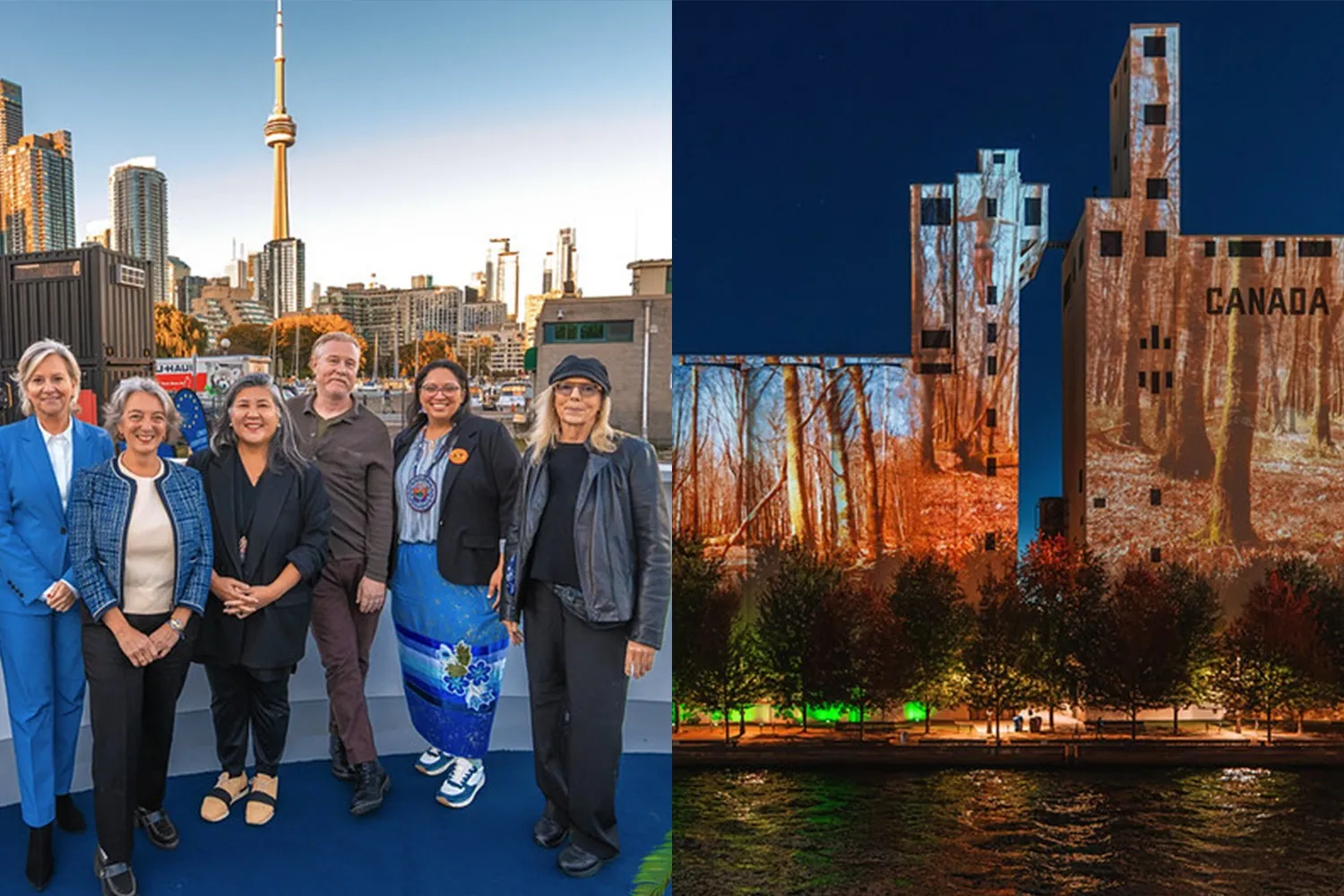
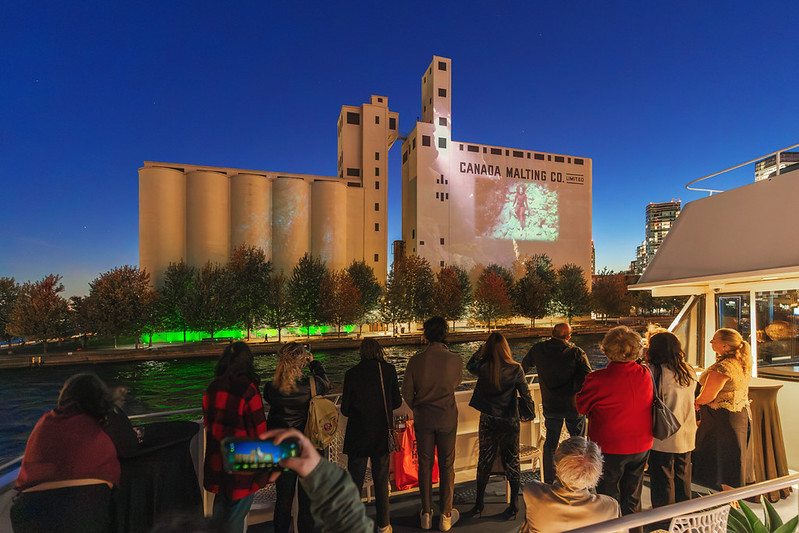
On Oct. 3, under a clear, cool evening sky, Toronto’s waterfront became a massive canvas for immersive art and climate reflection as two large-scale projection artworks illuminated the Canada Malting Silos as part of Nuit Blanche Toronto 2026. The works were co-presented by the Global Centre for Climate Action at OCAD University and the European Union (EU), through its Delegation to Canada.
The two works ̶ The Light by Irish artist Paul Murnaghan and Melting Temporalities by Canadian artists Claire Brunet and Johnny Ranger ̶ explored the theme, What We Carry Forward, inviting audiences to consider the relationships between memory, place, climate and the future, transforming the towering 350-by-200-foot silos into an immersive journey through water, ice, forests and living ecosystems.
Onlookers viewing the installation during Nuit Blanche.
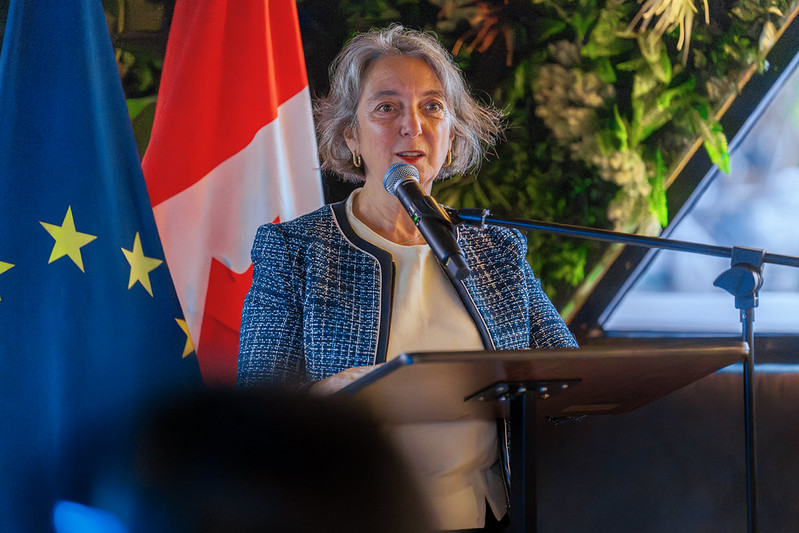
Before the installation’s launch, OCAD U and the EU co-hosted a reception aboard a boat, a setting chosen intentionally to reflect our deep connection to water. OCAD University President and Vice-Chancellor Ana Serrano welcomed the attendees, including artists and guest speakers Geneviève Tuts, Ambassador of the EU to Canada and Julie Dabrusin, Minister of Environment and Climate Change with the Government of Canada.
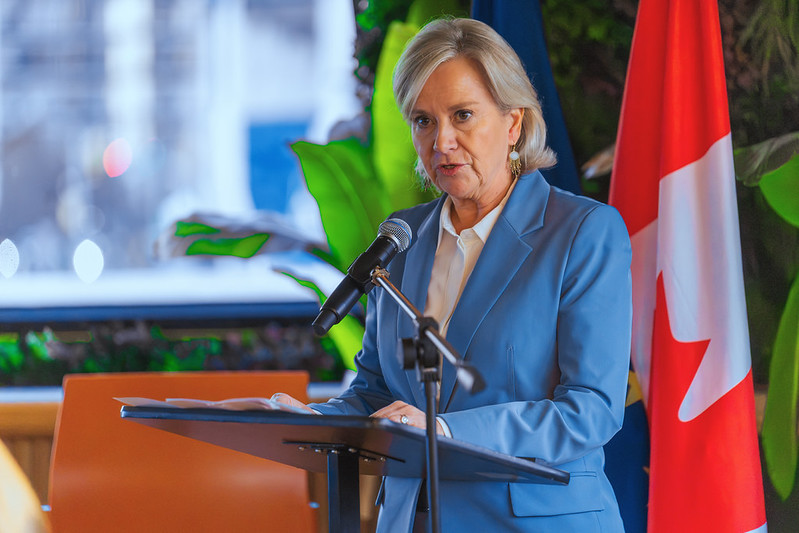
“Tonight, art, science and policy meet to tackle climate change,” said Ambassador Tuts. “The European Union is committed to reaching climate neutrality by 2050, but policy alone is not enough. Art moves us and culture changes our minds. Tonight’s projections, for the third year in a row, turns this industrial site into a living ecosystem. They don’t just explain climate change; they make us feel it.”
Geneviève Tuts, Ambassador of the EU to Canada
The evening reflected the shared commitment of the European Union and OCAD University to climate action, as well as the spirit of the EU-Canada Green Alliance, which advances shared climate and environmental goals. It also demonstrates how cultural exchange and creative practice can deepen dialogue and mutual understanding between Canadians and Europeans.
“As a vital cultural hub in the city and a global institution, OCAD University recognizes and values partnerships such as the one with the Delegation of the European Union to Canada,” said President Serrano. “Artists and designers give us ways to imagine futures that we may not yet have the words to describe and create new perspectives on the issues we share. As OCAD University celebrates 150 years, we’re proud to be a place where art, design and international collaboration come together to generate new ideas for the future.”
In her keynote address, Environment and Climate Change Minister Julie Dabrusin thanked President Serrano and OCAD University for bringing people together through research, art and climate action. She also reflected on attending several of the University’s year-end exhibitions, noting how impressed she was by the ways students reimagine complex issues and demonstrate how art and design can help advance climate action.
Government of Canada’s Environment and Climate Change Minister Julie Dabrusin
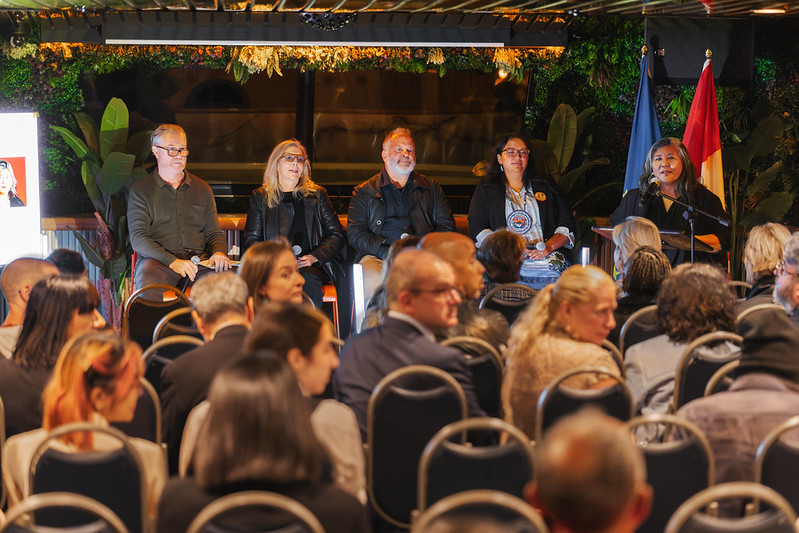
The evening included a panel discussion, moderated by President Serrano, featuring artists Paul Murnaghan, Dr. Claire Brunet, Johnny Ranger, and Dr. Kelsey Leonard, assistant professor at the University of Waterloo.
Panel discussion (left to right): Paul Murnaghan, Dr. Claire Brunet, Johnny Ranger, Dr. Kelsey Leonard and President Ana Serrano.
Together, the artists, researchers and educators explored how creative interventions can shift our understanding of climate change and help imagine more resilient futures.
Dr. Leonard, a water scientist, legal scholar, policy expert, writer and enrolled citizen of the Shinnecock Nation, said the climate and ocean crises are ultimately human crises, arguing that humanity is complicit in the negligent treatment of the ocean. She emphasized the need to pay greater attention to international gatherings intended to bring countries together and, more importantly, to turn those discussions into meaningful action.
Irish multidisciplinary artist Paul Murnaghan noted that the ocean is a place where humans do not truly belong. Reflecting on his experience observing the seafloor, he noted that the depths reveal how little we understand about the planet, while also exposing our environmental footprint through plastic and other debris.
He said that his work, The Light, developed for Nuit Blanche from the film, Against the Waning Light, “sends a message from the ocean depths to the intelligence of the forest, shifting the focus away from humanity and reminding us that, for once, it’s not about us.”
Dr. Claire Brunet, a professor in the Faculty of Art at OCAD University, said that her art “is a way of raising awareness about the issues shaping our time.” She added that Melting Temporalities aims to create an emotional experience that encourages audiences to think more deeply about global warming and its consequences for the environment.
Artist Johnny Ranger added that climate action needs to be approached in many ways, recognizing that people perceive and respond to the issue differently. He emphasized that while shocking documentaries are important, art should engage people without relying solely on climate anxiety. “Because art takes many forms—from the provocative to the contemplative—addressing climate change requires using different expressions to reach diverse audiences and tackle the issue on all fronts,” he said.
The Light and Melting Temporalities are also part of SILO NIGHTS at Public Pier, curated by OCAD University as part of Public Pier, presented by The Bentway, Harbourfront Centre, OCAD University, Waterfront BIA and The Toronto Port Authority. The October 3 presentation was a broader season of Public Pier programming supported by the Delegation of the European Union to Canada, bringing Canadian and European artists and students together through large-scale public art on Toronto’s waterfront.
Both OCAD U and the EU Delegation thank AVA Animation and Visual Arts, and Panasonic.
About the Delegation of the EU to Canada
The Delegation of the European Union to Canada is the official diplomatic representation of the European Union in Canada. As the EU's primary presence in the country, it works to strengthen political, economic, and cultural ties between the European Union and Canada. The Delegation facilitates dialogue on shared priorities including trade, climate action, security, and innovation through the implementation of the EU-Canada Strategic Partnership Agreement and the Comprehensive Economic and Trade Agreement (CETA). Its team promotes EU policies and interests, fosters people-to-people connections, and supports collaboration in research, education, and cultural exchanges. The Delegation serves as a vital link between Canadian stakeholders and EU institutions, while also providing information services to the public on EU developments and initiatives.
About Global Centre for Climate Action
Affiliated with OCAD University, the Global Centre for Climate Action is a research-creation centre at Canada’s Malting Silos that brings together artists, designers and researchers from around the world to host public events, exhibitions and programs, that engage people in creative action and dialogue towards a renewed climate future.