
Sabbatical Presentations: Dot Tuer & Keith Bresnahan
Talk
Alumni
Faculty
Graduate Student
International Student
Public
Staff
Undergraduate Student
Dr. Dot Tuer & Dr. Keith Bresnahan discuss their current research!
230 Richmond St. W
Room 322
3 - 4:30 p.m.
Faculty of Arts & Science
Faculty of Arts & Science
Free
230 Richmond St. W
Room 322
3 - 4:30 p.m.
Faculty of Arts & Science
Faculty of Arts & Science
Free
rgb(255,255,255)
Sabbatical Presentations with Dr. Dot Tuer & Dr. Keith Bresnahan
Join us for engaging presentations about the research Dr. Tuer and Dr. Bresnahan achieved during their recent sabbaticals.
The presentations are 30 minutes, followed by an audience Question & Answer period.
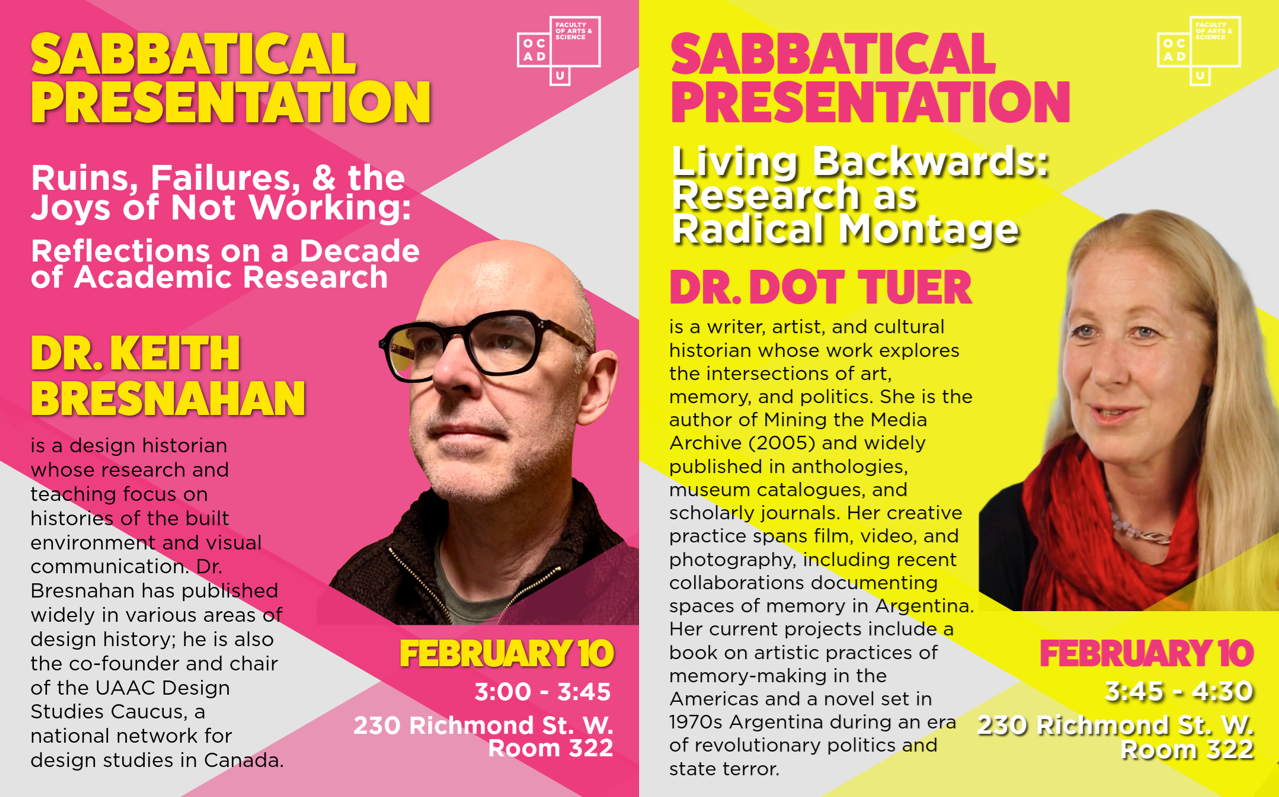
Dr. Tuer: Living Backwards: Research as Radical Montage
In this presentation, I reflect on how a sabbatical leave provides the free-flowing, slowed-down time for thinking, reading, and writing to coalesce into a creative practice of making connections between memories, history, ideas, and the world around us.
I suggest how this associative process serves as a research methodology of radical montage—one that produces new knowledge from disparate ideas and experiences—and discuss how it intersects with my ongoing community engagement in Corrientes, Argentina. In so doing, I make a claim for the importance, in Byung-Chul Han's words, of "living backwards"; that is, valuing creative daydreaming over digital scrolling and contemplation over productivity.
I conclude with brief excerpts from my book on art and memory and a novel-in-progress, both of which serve as material evidence of this contemplative synthesis.
About Dr. Dot Tuer:
Dot Tuer is a writer, artist, and educator whose work explores the intersections of art, memory, and politics. The author of Mining the Media Archive (2005) and curator of the acclaimed AGO retrospective on Frida Kahlo and Diego Rivera (Frida and Diego: Passion, Politics, Painting, 2012–13), Tuer has published over 100 literary and scholarly essays in anthologies, museum catalogues, and journals. Her creative practice spans film, video, and photography, including recent collaborations documenting spaces of memory in Argentina.
Tuer has an additional research focus on the history of transculturation in Argentina and Paraguay. She holds a PhD in Latin American History from the University of Toronto and has published on the confluence of Guaraní and Spanish spiritual practices in the colonial era and present-day popular culture. Drawing on the diverse threads of her artistic and historical research, she is currently completing a book on visual practices of memory-making in the Americas and a novel set in 1970s Argentina during a time of revolutionary politics and state terror.
At OCAD University, Tuer is a Professor of Visual and Critical Studies and the founding Chair of the program. She has also served as Chair of Criticism and Curatorial Practice and Acting Dean of the Faculty of Arts and Science. Her honors include a Toronto Arts Award, National Magazine Award, and OCAD’s Distinguished Research Award. Her artistic and scholarly work has been supported by numerous Arts Council and SSHRC grants.
Dr. Bresnahan: Ruins, Failures, & the Joys of Not Working: Reflections on a Decade of Academic Research
This talk will bring together some threads of my research and writing over the past decade, since the end of my first sabbatical (2016/17) and inclusive of my second (2023/24).
About Dr. Keith Bresnahan:
Dr. Keith Bresnahan is an Associate Professor in the Faculty of Arts and Science at OCAD University, where he has taught full-time since 2009. He is a design historian whose research and teaching focus on histories of the built environment and visual communication. Dr. Bresnahan has published widely in various areas of design history; he is also the co-founder and chair of the UAAC Design Studies Caucus, a national network for design studies in Canada. Current projects include book-length works on ruins and emotion in post-1871 Paris; on post-WWII projects for pictographic symbol language; a global study of ruins and architectural destruction from antiquity to the present; a cultural history of laziness; an edited volume on architecture and the history of emotions; and the first survey of graphic design history in Canada.
Please be advised that OCAD U hosted events may be documented through photographs and video. These images may be used by the University for promotional, advertising, and educational purposes. By participating in our events, both on campus and off-site, you consent to allowing OCAD University to document and use your image and likeness. However, if you do not want us to use a photo or video of you or your child, please don’t hesitate to let us know when you arrive at the event. You’re also welcome to get in touch with OCAD University’s Marketing & Communications office: communications@ocadu.ca.
Be mindful of those in our community who have scent sensitivities; please help OCAD U maintain a healthy, scent-free campus.