
Research Talks with: Ian Clarke, Angus Mok, & Ashar Mobeen
Lecture
Alumni
Faculty
Graduate Student
International Student
Public
Staff
Undergraduate Student
FAS Research Talks: Ian Clarke, Angus Mok, & Ashar Mobeen
100 McCaul Street
Room 543
12 - 1 p.m.
Faculty of Arts & Science
Faculty of Arts & Science
Free
100 McCaul Street
Room 543
12 - 1 p.m.
Faculty of Arts & Science
Faculty of Arts & Science
Free

rgb(255,255,255)
Research Talks: Ian Clarke, Angus Mok, and Ashar Mobeen
Join us!
Faculty of Arts and Science faculty members discuss their research and current projects in this Brown Bag Research Talk!
Read below for more information about our speakers!
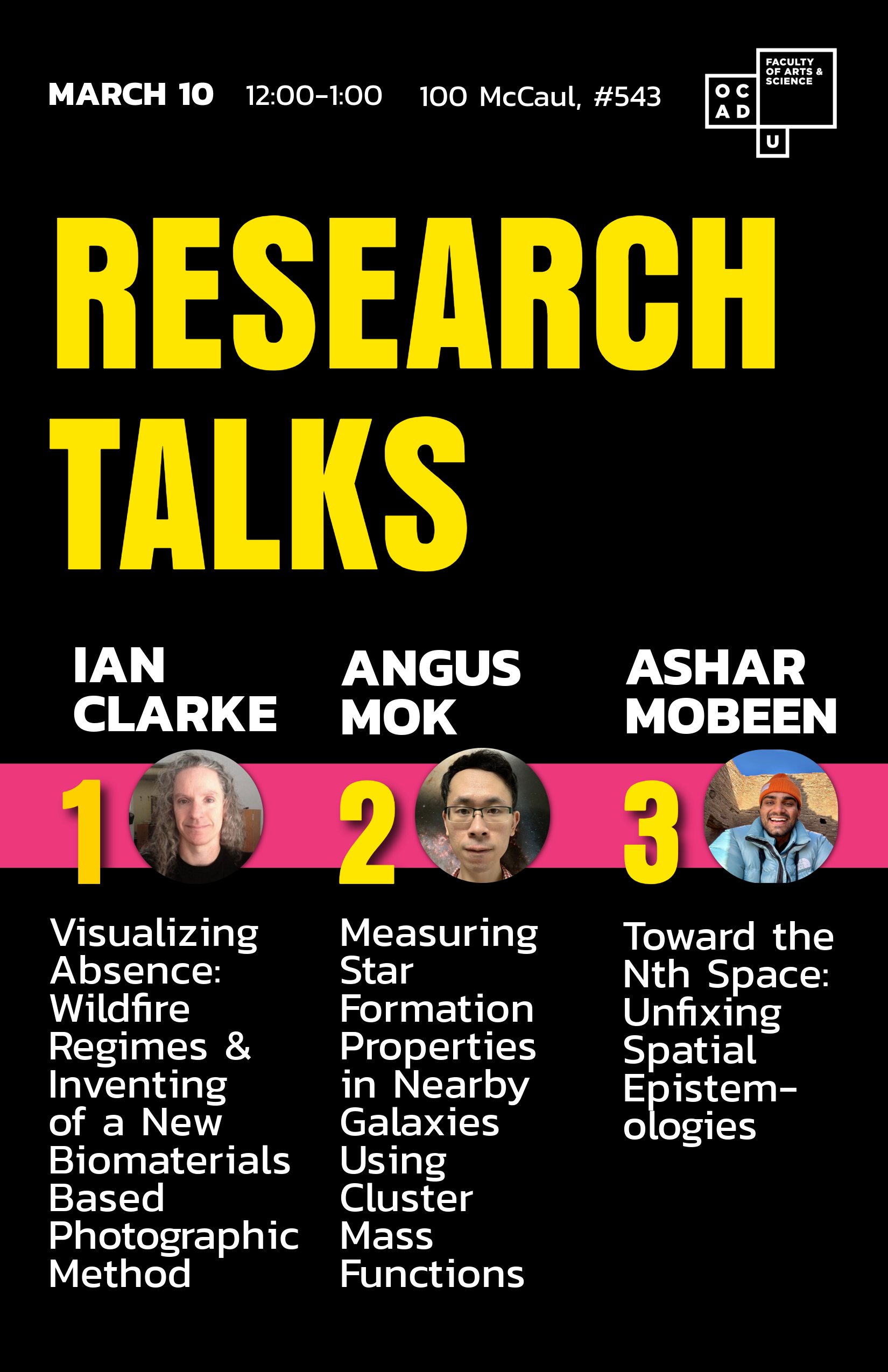
Ian Clarke:
Visualizing Absence: Wildfire Regimes & Inventing of a New Biomaterials Based Photographic Method
Ian will discuss one of his current research projects that started with experiencing forest wildfires and resulted in the invention of a new biomaterials based, completely non-toxic, photographic printing method.
Biography: Ian Clarke is an Associate Professor of sustainability and biology in the Faculty of Arts and Sciences and the School of Graduate Studies at OCAD University. He is a 2025-2026 BMO Sustainable Futures Faculty Fellows. He received his Ph.D. in Biochemistry from Queen’s University and an AOCAD (printmaking) from OCADU. He trained as a Biologist at the Design Table (BaDT) and has been a Biomimicry Education Fellow at the Biomimicry Institute. He has taught at OCAD University since 2003, was part of drafting the first OCADU Sustainability Policy, and was one of the founding Co-Chairs of the OCDU Sustainability Committee. He has served as Associate Dean and Interim Dean of FAS and Prior to moving to OCADU full time, he was was a cancer stem-cell researcher at the Arthur and Sonia Labatt Brain Tumour Research Centre at the Hospital for Sick Children (Toronto). He has co-authored numerous peer reviewed scientific articles in journals such as Nature, Cancer Cell, Cancer Research, Proceedings of the National Academy of Science (USA) and Cell Stem Cell. His publications have received over twenty-three thousand citations in peer reviewed journals. He teaches courses in biology, biotechnology, climate change and sustainability sciences. His research at OCAD University focuses on sustainable art & design materials such as non-toxic biomaterial based photography and mycelium based materials, as well as urban agriculture and ecology, with a specific focus on cultural adaptation to the climate crisis.
Angus Mok:
Measuring Star Formation Properties in Nearby Galaxies using Cluster Mass Functions
Star clusters offer a powerful window into the recent star‑forming activity of nearby galaxies. In particular, the distribution of cluster masses can reveal key information about the process of forming stars from the gravitational collapse of molecular gas clouds. This talk will discuss how clusters can be identified from telescope images and what the slope, normalization, and shape of the cluster mass function may reveal about the star formation properties of other galaxies.
Biography: Dr. Angus Mok is an Assistant Professor (teaching stream) at Faculty of Arts & Science. Before joining OCAD, he received a PhD in Astrophysics from McMaster University and was a postdoctoral researcher at the University of Toledo. He continues to contribute to astrophysics research, with a focus on the star formation process in nearby galaxies.
Ashar Mobeen:
Toward the Nth Space: unfixing spatial epistemologies
This talk introduces the concept of the Nth Space—a speculative framework that expands upon Edward Soja’s idea of Third Space to think beyond fixed spatial categories altogether. Rather than asking how space can be classified, the Nth Space asks how space is felt, lived, and continually becoming. Drawing from decolonial theory, Indigenous cosmologies, diasporic poetics, and speculative physics, I explore space as relational, unstable, and co-constituted through memory, embodiment, ritual, and affect. Through examples from contemporary artistic practice and my own research-creation, I argue that spatial experience is not simply something we inhabit, but something we actively produce in relation to histories, bodies, and more-than-human worlds. The Nth Space is proposed not as a new model to replace existing theories, but as a gesture toward openness—one that resists closure, embraces multiplicity, and foregrounds ways of knowing that exceed Western spatial logics. Ultimately, the Nth Space offers a language for thinking about space as a site of survival, care, and world-making.
Biography: Ashar Mobeen is a writer, curator, and fourth-year ABD PhD candidate in Art and Visual Culture in the Department of Visual Arts at Western University. His research investigates how ancient and Indigenous civilizations articulated sophisticated astronomical knowledge through art, architecture, and spatial design, and how these cosmologies offer critical counterpoints to Eurocentric histories of science. Centering the stories and knowledge systems of communities marginalized by colonial epistemologies, his work examines the intersections of visual culture, cosmology, ecology, and speculative theory. Ashar’s scholarship brings ancient and Indigenous worldviews into dialogue with contemporary scientific and philosophical models, including decolonial theory, affect theory, and speculative physics, with particular attention to questions of relationality, embodiment, and environmental consciousness in the context of the Anthropocene. Alongside his research, he is committed to developing interdisciplinary and decolonial pedagogical approaches that integrate art, science, and critical theory in the classroom. Beyond academia, Ashar is actively engaged in curatorial and public-facing projects. He has contributed to exhibitions such as In the Heart of the Bronze: A Liu Shiming Experience and of many worlds in this world at Western’s artLAB Gallery. He is also the host and co-producer of the Ecologies in Practice podcast series, which explores intersections of art, sustainability, and environmental justice through conversations with artists, curators, activists, and scholars. His practice moves fluidly between research, writing, curating, and research-creation, foregrounding art as a site of knowledge production, ecological imagination, and world-building.
Please be advised that OCAD U hosted events may be documented through photographs and video. These images may be used by the University for promotional, advertising, and educational purposes. By participating in our events, both on campus and off-site, you consent to allowing OCAD University to document and use your image and likeness. However, if you do not want us to use a photo or video of you or your child, please don’t hesitate to let us know when you arrive at the event. You’re also welcome to get in touch with OCAD University’s Marketing & Communications office: communications@ocadu.ca.
Be mindful of those in our community who have scent sensitivities; please help OCAD U maintain a healthy, scent-free campus.