## Breadcrumb
1. [Home](/)
2. Markdownify
3. Node
4. [Heather Gentleman](/markdownify/node/4978)
# Heather Gentleman
Instructor Profile
KeywordsSchool of Continuing Studies
rgb(255,255,255)
#### Could you talk about the value and relevance of studio courses at a time when the presence of digital and AI-generated images is ubiquitous in visual culture?
There really is no replacement for the human touch in art making. Al takes what has already been created and spits it out in a new form. When working by hand, the results are endless and are only restricted by capability, which can be learned and developed by engagement in regular practice. There is also no room for “mistakes” which often redirect where a work is going. I see my process as a relationship between myself and the work. There needs to be room for experimentation and risk-taking in making art. AI doesn’t allow for that. Much like searching on Google for a correlation between two subjects to support an idea instead of reading various books, AI is prescriptive and doesn’t allow for discovery.
#### What skills do you teach in Drawing Skill Studio 1 and 2? And how do you respond to someone who says 'I cannot draw'?
In [Drawing Skills 1](https://tinyurl.com/bd458ust), I teach basic drawing skills, beginning with observational drawing of still life. Throughout the course, students learn skills that are scaffolded, starting with proportion and measurement, then value and form. We then move to architecture where students learn about composition and perspective. Follow onto portraiture where students apply the techniques acquired through still life, then to anatomy working with life models. I tell students if they can learn the techniques in Drawing 1, they can learn anything. In [Drawing Skills 2](https://tinyurl.com/23y2v7ah), students delve into more detailed techniques such as drawing hands and feet, fabric, and working from a clothed model. They also learn how to develop concepts and narratives and build their own drawings based on their interests and focus.
#### How does taking a painting course enrich our observation skills, and ability to depict colour and three-dimensional space?
It is best to hone observational skills through drawing. If that has already been developed, it can be broadened through painting. Whether working from a reference or a still life, a [painting course](https://tinyurl.com/2whcpjwb) will help students continue to explore how measurement, proportion and perspective are inherent to creating a representational image. Learning how to see is keenly important. I often have my students crop small areas of a reference to isolate the colour which can sometimes be quite revealing and surprising. With any kind of observational work, it is important to put aside what one thinks one sees and see what is truly there.
A painting course can also teach students the properties of colours and value such as a shadow consisting of both the colour of the object and its complementary or reflective colour from a surface which bounces back onto the object. Understanding how value works is inherent in creating a three-dimensional painting which includes form shadow, cast shadow, the terminator line and the bounce of light. After learning this in a painting course, the student can continue their own practice with these skills.
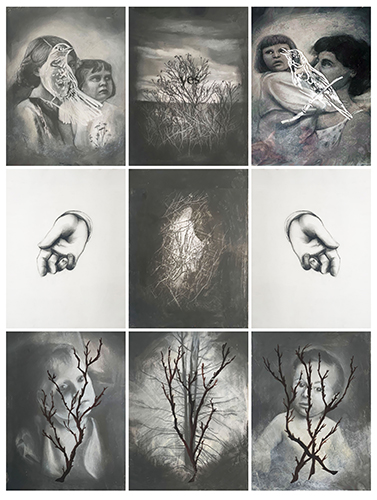
Full of Grace, Conte and charcoal on paper, ink and transfer on acetate 27” x 38” (9" x 11" each) 2022 © Heather Gentleman
#### You participated in the Arctic Circle Residency this summer. Could you tell us a little bit about the experience?
The Arctic Circle Residency is located upon a traditionally rigged Barquentine Tallship, which circled the high Arctic Svalbard Archipelago, an expansive landscape of glaciers, wildlife and fjords, 1,050 kilometres from the North Pole. The tour included 29 artists and 8 crew who explored a variety of terrain and locations.
Each day we would go to a new area and have the option to set out on a zodiac to a landing, two times a day. Sometimes the zodiac would take us to film an iceberg or take us through ice fields. Each landing included three guides, armed with rifles, who established a perimeter to be on the lookout for polar bears, who were plentiful.
The experience left me with a sense of peace and being a small part of a larger world. I was often left in awe of the beauty of the Arctic, such as the turquoise blue of an iceberg in a deep green ocean, against a mauve sky with indigo striped mountains behind, or the cacophony of birds filling the sky, sparkling with the reflecting 1:00 am sun, swarming their nests in the mountains. We were followed by curious seals and foxes, watched walruses resting in the sun and observed a polar bear amble across rocky terrain into the sea.
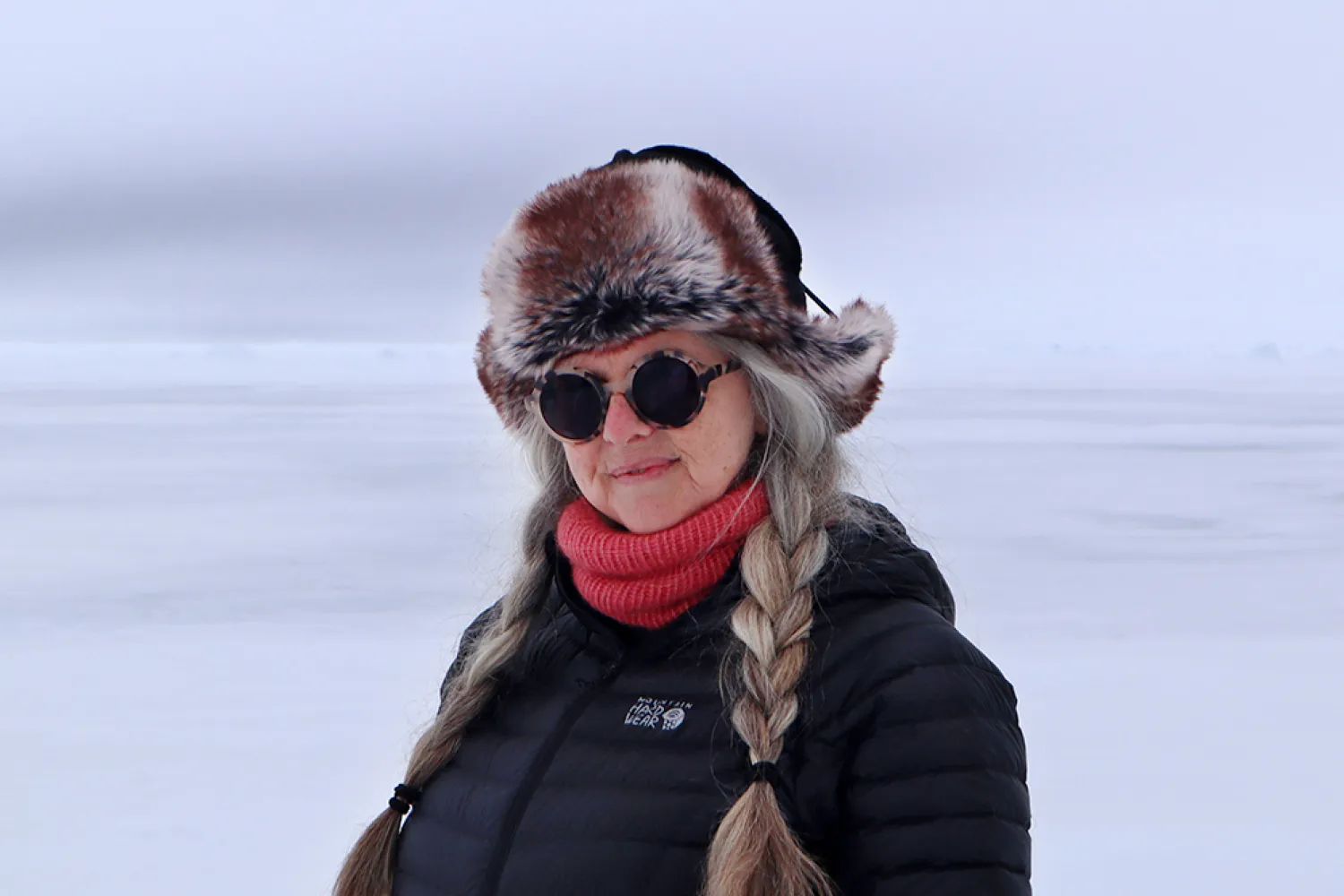
The most momentous experience, however, was the trip into the choppy Arctic Sea to the pack ice where we encountered an otherworldly space. Only 1,000 km from the north pole, it was the farthest one can go by boat. The sky and land became one misty palette and gave a sense of eternity. I had the opportunity to walk with a guide on this terrain, considering the treks of Admundson and other explorers, until he stopped us and said he heard cracking and we needed to head back to the boat.
Other significant experiences included laying on a small ice flow, while the zodiac waited a short distance away, and encountering a crashed nazi plane. It was truly an experience of discovery and adventure as well as a deepening understanding of my place in the world.
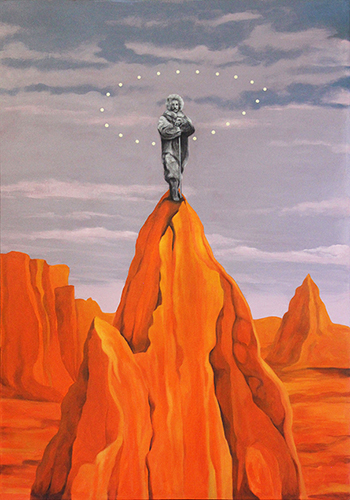
Adventure is just bad planning, Roald Amundsen, Charcoal, Oil and Acrylic on Canvas, 95 x 140 cm, 2020 © Heather Gentleman
#### What are some upcoming projects you are working on or looking forward to developing?
I’m working on two series at the moment. The first is shown in this article, called “The Five”. This work places side by side the five women artists who formed a group of the same name and the five women who were killed by Jack the Ripper.
Both groups were contemporaries, but they differed in many ways. The former group included the infamous Hilma af Klint, who chose not to marry but live with her female friend. Their liaison may have been romantic but there is little information to support it. Coming from comfortable backgrounds, these women were also able to go to art school and support themselves through their art.
The Five women who were victims of the Ripper had been married, save one, and had lived in poor conditions after leaving their partners. One was a sex worker, and the rest worked tirelessly taking in small sewing jobs and the like to sustain themselves and possibly find a doss to sleep. Many slept rough, which made them vulnerable to crime.
I have painted five 42” x 10” panels derivative of Hilma af Klint’s Paintings for the Temple. I have also created five 42” x 10” panels of black and white digital collages of the Ripper women which will be printed on linen and embroidered. My wish is to show them in a way that they would have liked to have been seen, not as corpses as titillation. I reworked their images, clothing them in beautiful dresses, surrounded by Victorian floral motifs. I plan to hang these from the ceiling as an installation to create a dialogue between the two groups.
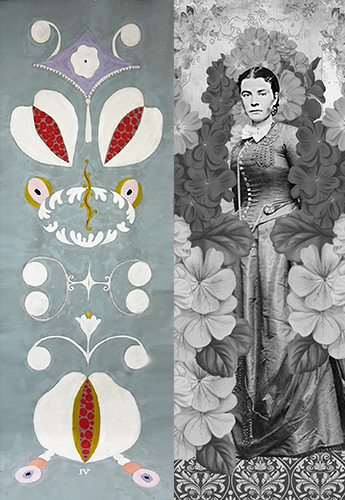
Four (The Five), Acrylic on raw canvas, digital print on linen, Each panel 42” x 120”, 2024 © Heather Gentleman
I am also working on a series based on my experience in the Arctic called Wherever I go, there you are. The work consists of projections on whale bones and inside hunter cabins, compositing on icebergs and eight 4’ x 8’ paintings. Just before my Arctic residency, I had lost my mother and found that the peace of the Arctic created a place for me to be still with my memories of her.
We were walking on a beach, and I saw whale bones and thought about the idea of death in the Arctic. I thought that I could recreate the whale in my mind, but it would never be exactly as it was. We do that with our memories of those who have passed by forming a narrative with what impacted us. They are only remnants, however, and never the full story. There are so many pieces missing, such that they will never be whole again. I came across a massive whale skull from the 17th century, upon which I projected images from my mother's memorial, which served as remnants. In each of the paintings, I will be drawing an image of my mother, referenced from archival photos, small and ghostly within the vast landscape.
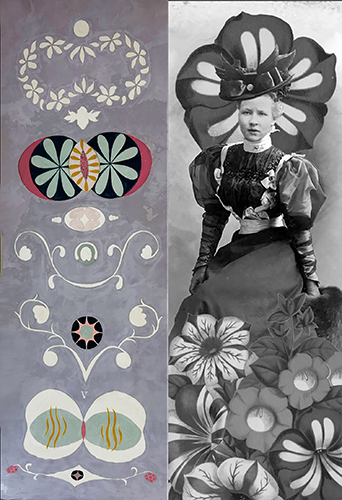
Five (The Five), Acrylic on raw canvas, digital print on linen, Each panel 42” x 120”, 2024 © Heather Gentleman
—
Website: [hagatelier.com](http://www.hagatelier.com)